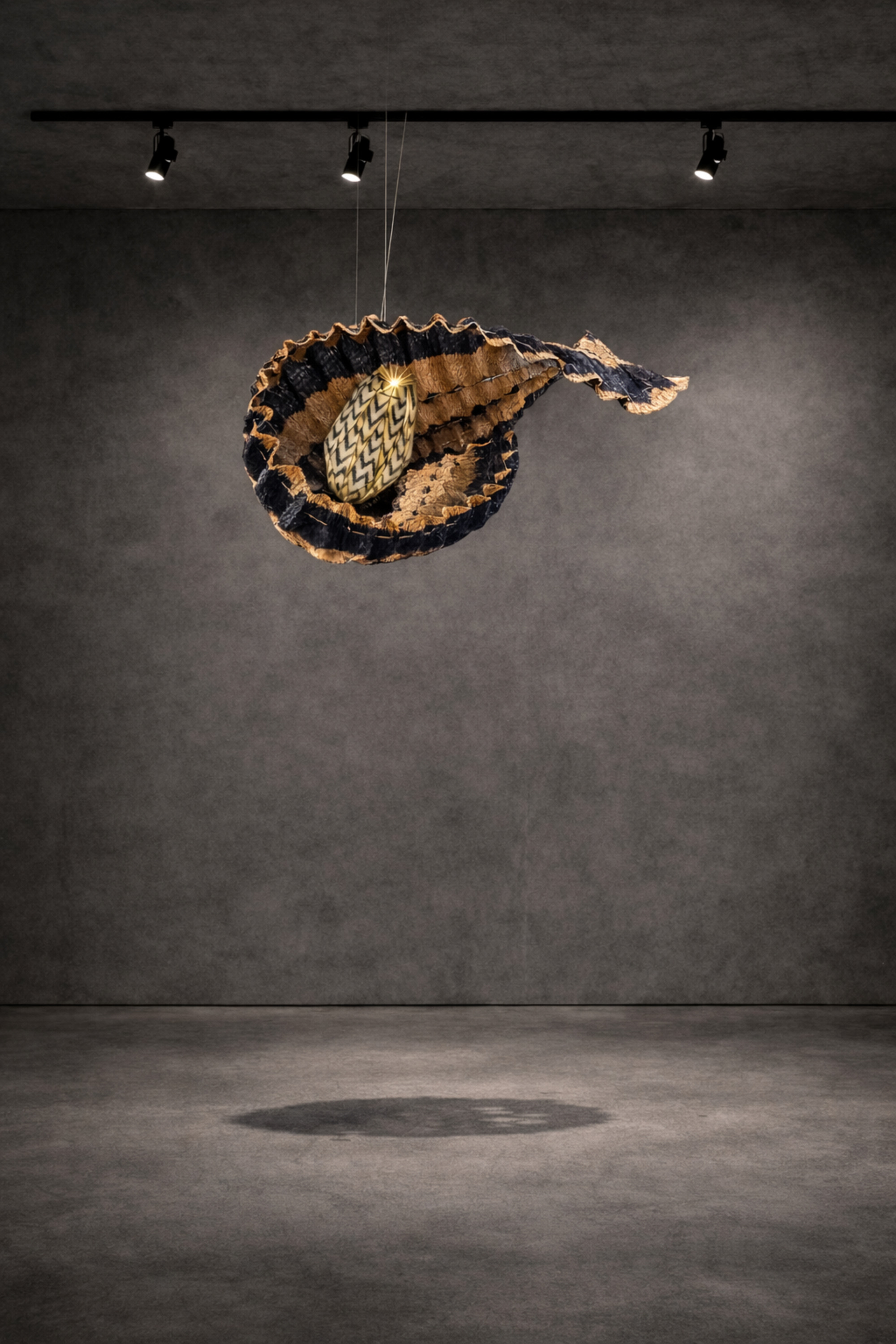
সাধারণ অসাধারণ (The Extraordinary in the Ordinary) I
INR 81,000 + GST
.JPG)
introduction
Bashobi created the pattern designs for the mats and worked closely with her artisans (insert names here after asking Bashobi). In Bengal these Chataais are called ‘Maadur’ and are made from ‘Maadur-Kaathi’, a river sedge or reed, scientific name being Cyperus corymbosus or Cyperus tegetum, that dry into stiff twigs. The mat-making technique typically uses cotton or jute threads as the warp.
They differ in weave density and quality : Ekhara is single-woven, Dohara is double-woven (finer), and Masland is the finest, most intricate, and luxurious mat. Ankon’s studio team then wet these mats for 48 to 72 hours and then folded them by hand to the predetermined patterns. While folding the mats are continuously dowsed with water to keep them wet.
The 3D folding patterns are based on the black and beige base 2D weaving patterns of the mats. After the final folds are achieved, the mats are flat-packed and tightly wound with ropes and left to dry in shade. On drying the folds/pleats become permanent. The forms are then opened out, the metal armatures / under-frames are added and the lighting incorporated. This is a project created across 3 locations – Bashobi in Kolkata, her artisans in Medinipur and Ankon in Delhi.
reflection
"He who sees all beings in the Self, and the Self in all beings, thereafter begins to comprehend Ekatvam (Oneness)." - Isha Upanishad, Verse 6
The reed grass is a very inexpensive and ordinary material. The craft of creating the Maadur mats is millennia old and used to be a utilitarian staple in Bengali households for siting and lying down on the floor. Bashobi recognized the extraordinary potential of this ordinary medium and began infusing the technique with design and pattern inputs.
She enriched the crafts persons and they enriched her in turn. A design educated English-speaking city based designer interacted with a cluster of near illiterate hands-on skilled Bengali-speaking rural crafts people and both found expansion and joy from this interaction. Sonder happened. Then Bashobi met Ankon and the worlds of 2D and 3D collided, new chemistry emerged.
Again Sonder happened. Many new projects will bloom from this first interaction. Sonder creates beautiful networks of innovation and joy. It unearths meaning in places of which we knew nothing before.
.PNG)
.jpg)

